Foreword by Engelbert Schmid
Horns contain dozens of nickel silver parts. Nickel silver contains between 12 and 18% nickel; the rest is copper and zinc – there is no silver in it at all. Nickel silver of turning quality contains about 3% lead. Incidentally, the nickel silver used for the slides and valve casings of Engelbert Schmid horns contains no lead.
Nickel silver parts are very practical, as the alloy is very stable and durable and, with 3% lead, easy to turn on the lathe. Its colour also matches all the other alloys: yellow brass, gold brass and sterling silver. But the nickel content can make horn playing hell, or even impossible, if the player has a nickel allergy – which is not rare at all. Probably many horn players don't know that their allergic reaction comes from the nickel in their instrument.
Interview
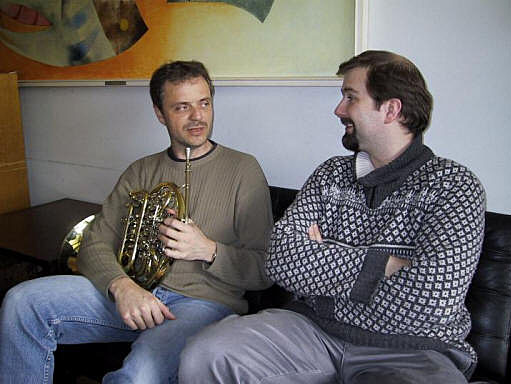
Martin Gottschalk, principal horn of the Sønderjyllands Symfoniorkester, interviews his colleague Lars Kristiansen (2nd horn in the same orchestra) and the horn maker Engelbert Schmid.
Gottschalk to Kristiansen: How serious were your problems with the nickel allergy?
Kristiansen: It was about to get very serious, but I stopped playing in time. I've had a nickel allergy since I was about 12; I noticed it because I couldn't wear a necklace.
When I started playing the horn at the age of 15, I didn't have any problems for the first couple of years. As far as I remember, I was about 20 when my fingers started reacting to the bell, where the lacquer had worn off – and I had been playing a nickel silver instrument all that time. For the next 10 years I used finger gloves, which worked well, but at the age of 31 I started to get many allergic reactions. Approximately every third week I had sores in my mouth; my mouth was also very dry, and sometimes I had a burning sensation in it.
I also had many other symptoms, such as headaches, rashes and weak burning sensations all over my body (like the flu), especially on the top of my head and on my right thigh (I thought that could be a reaction to my car keys). Worst of all, I was very tired. Later I found out that I had also developed a grass allergy and that I reacted to food with a high nickel content, such as nuts, soy and chocolate.
Gottschalk to Schmid: How did you react to the first inquiry?
Schmid: It came by e-mail, so I could think about it a little first. Then I wanted to know how serious the inquiry was and whether he was allergic to other metals as well.
Kristiansen: Mr Schmid took my inquiry seriously and was very interested from the beginning. I had contacted several other horn makers, and the only help they could offer was gold plating on the outside of the instrument. That wouldn't have helped much, because I breathe in through the instrument and react to the nickel-laden air – a habit I couldn't get rid of if I wanted to keep playing at a professional level. I was interested in a completely nickel-free horn.
Schmid: I told Mr Kristiansen that if I made a nickel-free horn, I would not compromise in any way, i.e. I would replace every part containing nickel. When I made a list of the parts to be replaced, I was very surprised myself to find that more than 40 parts on a double horn contain nickel. Even the steel springs, the steel axles and the stainless steel screws contain nickel! I realised that it would be very costly to replace all these parts with the same precision and similar durability throughout. It was clear that I could not charge all the extra costs to a single horn, and that I could not make or order the parts for just one instrument. For example, we needed specially made tubing for the valve casings and the slides, which is not possible in very small quantities. Organising all this was extremely time-consuming. Just one example: an ordinary water key consists of four parts containing nickel. In the time we invested in the nickel-free horn, we could have built two triple horns, with much lower material costs. But I wanted to help Mr Kristiansen and promised to build him such a horn, completely without nickel.
Gottschalk to Kristiansen: Do you still have any allergic reactions?
Kristiansen: As I mentioned, I have also developed an allergy to nickel in food, but I can control it. As long as I keep my craving for chocolate and nuts in check, I don't have any reactions. As for the instrument itself, there are no reactions whatsoever, and it is nice to be able to play without finger gloves. Mr Schmid even supplied me with a nickel-free case and a gig bag for flying.
Gottschalk to Schmid: Is there no trace of nickel at all in the materials you used?
Schmid: Obviously practically none, as Mr Kristiansen no longer has any reactions at all. But the suppliers of the raw material admit that the yellow brass may contain up to 0.3% nickel. I told Mr Kristiansen, and that is why he ordered the horn with a sterling silver body, i.e. bell flare, bell tail, first branch, leadpipe and hand guard made of sterling silver (92.5% silver, 7.5% copper, no trace of nickel). These are the parts of the horn you touch most often. We silver-plated the yellow brass finger plates and levers, and the whole horn was lacquered with particular care to make sure there is no contact with nickel. Personally, I think that a carefully lacquered brass body would help in many cases, too.
Kristiansen: I don't think that would have worked in my case. Besides, most instrument makers don't lacquer their instruments carefully. It also depends on your own sweat; I know people whose sweat strongly attacks the metal.
Gottschalk to Schmid: So in many cases, wouldn't a normal horn with nickel silver parts but intact lacquer solve the problem as well?
Schmid: No, certainly not. For example, you come into contact with the oil from the nickel-containing steel axles, and the most crucial factor is the air you inhale from inside the instrument.
Gottschalk to Kristiansen: How has the instrument worked out in the end? Do you get on well with it?
Kristiansen: Yes, I like it a lot. It is completely different from the horn I always used to play (a Holton Farkas), but after a period of getting used to it I really wouldn't want to change back. I think it is truly a professional horn: very reliable intonation and splendid tone quality, much better slurs, it is easy to play fast, and the valve levers are well positioned. I've had some problems with the valve casings because they are made of brass, but that may just be until I learn to oil them properly. I would suggest a horn with titanium valve casings as the optimal solution. Apart from that, with its combination of yellow brass, gold brass and silver, it is a very nice horn to look at, and quite a few of my colleagues have noticed that too.
Schmid (note): What really decides how freely the valves run are the bearings. A titanium valve casing would be impractical and would not change anything about how freely the valves run!
Gottschalk to Schmid: Are these characteristics due to the lack of nickel in the horn?
Schmid: No, not at all. Mr Kristiansen ordered a wide sterling silver bell; that is why it sounds this way. A nickel-free Engelbert Schmid horn is available with all the different sound variants – see Bells. The other characteristics are typical of Engelbert Schmid horns. The challenge was to build a nickel-free horn with the same acoustic and playing characteristics as a normal Engelbert Schmid double horn. At times there were strong temptations to accept compromises that would have been much cheaper but would have damaged the quality of the horn.
Gottschalk to Schmid: Can you now build your entire range of models nickel-free?
Schmid: Yes, it is no problem to build a triple horn or any other model from our range without nickel, too. As we make everything ourselves, from the bell to the valves, we are now flexible enough to build every model nickel-free.
Letter from a Canadian customer
A customer from Canada who bought a nickel-free horn in 2007 wrote to Engelbert Schmid:
Dear Engelbert Schmid,
After 6 months of playing on my sterling-silver, nickel-free horn, I wanted to write a note of thanks to you and your production team. Every day I admire your craftsmanship and fall in love with this horn all over again. I have had no problems with my nickel allergy since I began playing this instrument – it has given me back my career and my life, and I'm eternally grateful!