
Ball-and-socket or string action?
Most professionals prefer a string action, while many amateurs order ball-and-socket linkages. If you examine the mechanism more closely, the reason becomes clear.
Ball-and-socket action
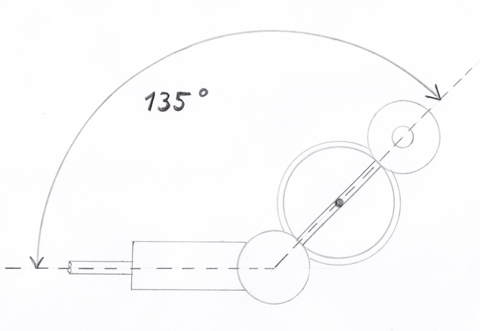
In its starting position the ball-and-socket action is at a mechanical angle of 135° – not really bad, but not ideal.
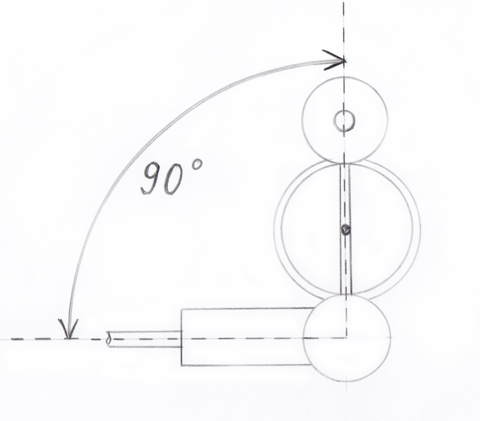
Half-way through the stroke it reaches the ideal angle of 90°, where the mechanical advantage is greatest.
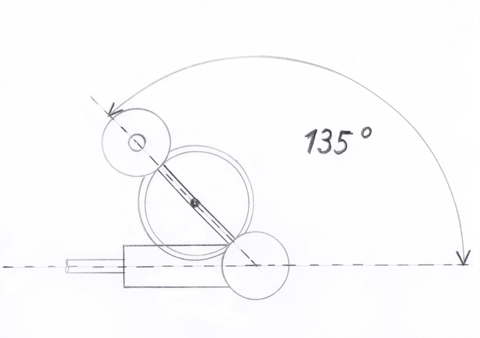
Fully pressed, it is back at the less favorable angle of 135°. This means that the beginning of pressing and of releasing requires more force, so the effort is uneven.
String action
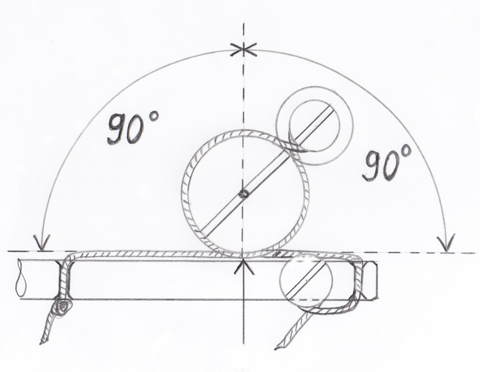
With a string action, the string always pulls at the right point, which gives the ideal mechanical angle of 90°. This is why a string action can be geared for a shorter stroke. A ball-and-socket action has to be given a longer stroke so that it does not feel sluggish.
The string has further advantages: it is cheaper, it cannot rattle, the height of the levers can be easily adjusted, and it can be replaced practically anywhere in the world. Incidentally, the string only breaks if it is cut by a burr – and there are no burrs on Engelbert Schmid horns. Modern string materials do not break or stretch and rarely need replacing.
For those who still prefer a ball-and-socket action, we have chosen very light, nickel-plated balls with extremely durable nylon sockets. The light weight is crucial for the long balance lever of the full triple horns.