
Every horn player knows that the 5th and also the 10th harmonics are noticeably flat compared to the practical intonation used in everyday musical life.
This is due to the fact that musicians had to find a way of tuning that allows them to switch between different keys: tempered tuning. Only in hunting music or on rare occasions, such as the final chords of a piece, is the 5th harmonic, the major third, used in natural intonation.
5th harmonics on the F side
In the USA and also in some other countries, there is a tradition of playing the middle range on the F side of a double horn. Many hornists like the sound, and it is also very good lip training, but in fact everybody is more or less fighting with the intonation:
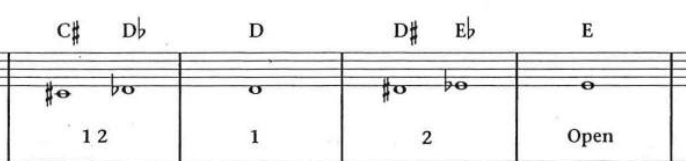
For 33 years my Engelbert Schmid horns had the same natural intonation on these 5th harmonics on the F side, and nobody ever complained, because horn players know about this acoustic reality. Correcting it and getting along with it is considered normal horn playing technique.
Correction by hydraulic inflation
In 2024 I decided to inflate the two F loops of the double horns by hydraulic pressure in order to make production more independent of me. So far we have not saved any time, because I always bent the long F loop, for instance, in one piece within 5 minutes. In the video “Handwerkskunst” on the YouTube channel Engelbert Schmid Horns (so far only available in German), you can watch me doing this in real time within 4 minutes, from 10:43 on:
Video “Handwerkskunst” on YouTube
But with the hydraulic inflation method I saw the chance to correct these 5th harmonics on the F side. My computer measuring system tells me exactly where I have to enlarge or reduce the inner bore very slightly in order to correct these notes without damaging any others. The enlargements and reductions are within 1/10 mm and totally invisible, but they correct these notes almost entirely to the intonation of tempered tuning. Now it's a pleasure to play these notes on the F side.
Whenever I design a horn part for the hydraulic inflation method, I never use a good sample for moulding, because the part would then contain the mistakes of the original plus those of copying. No, I create the mathematics for the part – the 100% bore profile plus the shape of the part – and then the mandrel is machined with a tolerance of 1/100 mm. The tolerance of our finished part is within 3/100 mm.
5th and 10th harmonics on the Bb side
It's impossible to correct all 5th and 10th harmonics, and it is also not necessary. On the Bb side there are only three notes of the 5th and 10th harmonics which should be close to tempered intonation:
The middle G on the Bb side and two of the 10th harmonics:
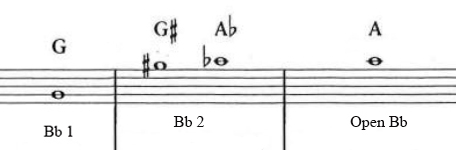
From the beginning, these three important natural thirds have been very usable on Engelbert Schmid horns.
The goal of my work is to make the lives of horn players easier.