An article for the Swiss magazine “Brass Bulletin”, published in 1985 – still up to date in every word.
At the age of 20, as first horn in a professional orchestra, I already felt that a Bb horn combined with high Eb would be ideal for so many passages.
Many years later, when I held such an instrument in my hands for the first time, I immediately had the feeling that I had always played this model. The fingerings came automatically, as if they had always been in my fingers. Nevertheless, some hornists are so used to the high F fingerings that they can't or don't want to change. There are also many who, on principle, want to play almost everything on the double horn. I have no objection to that.
Although the models with high Eb have been in my catalogue since 1981, many hornists still don't know about them. Three of them are presented here individually.
When high Eb is worthwhile
One should not switch to the high Eb combination for the sake of security alone. Basically, the combination with high Eb is only suitable for those who feel really secure on the Bb side up to G''. For the two notes F#'' and G'', the high Eb horn does not offer more security. The main reason for using high Eb should be that it ultimately sounds better or responds faster.
The following examples, chosen from hundreds, show that the high Eb horn can offer advantages in all registers.
More precise, faster response
Examples of a more precise, faster response without any audible loss of tone and with optimal intonation:

More security
Examples of more security without any audible loss of tone and with perfect intonation:

The high register
From G#'' to A#'' the 8th or 9th harmonic of the high Eb horn can be used!
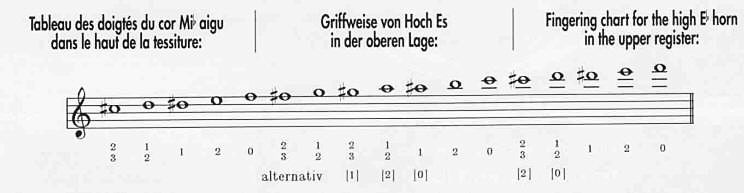
Only F#'' and G'' have different fingerings than on the Bb horn!
From G#'' upwards, the high Eb horn – especially on the 9th harmonic – has an excellent fortissimo, in no way inferior to that of the Bb horn. The sound actually tends to improve, because one feels completely safe and can just “go for it”. Using high Eb does not make you as dependent on the short horn as is the case with high F.
It is not my intention, with this presentation of the Bb/high Eb horn, to talk anyone out of staying with the double horn, the Bb/high F horn or the triple horn with high F. Of course, these models are also in my catalogue, in their most advanced form.
Bb side can be lowered to A and raised to B natural
Let me add one more thing: on all my models, the Bb side can be lowered to A and – even more useful – raised to B natural! This means that on the B natural horn it is possible to play passages for horn in E with the fingerings for horn in Eb! For example Weber's Concertino, Danzi's Concerto, “Fidelio”, “The Thieving Magpie”, “Così fan tutte” etc. with Eb horn fingerings! All of a sudden these pieces become rewarding to play!
Three models with high Eb
Bb/high Eb horn with A-stopping valve
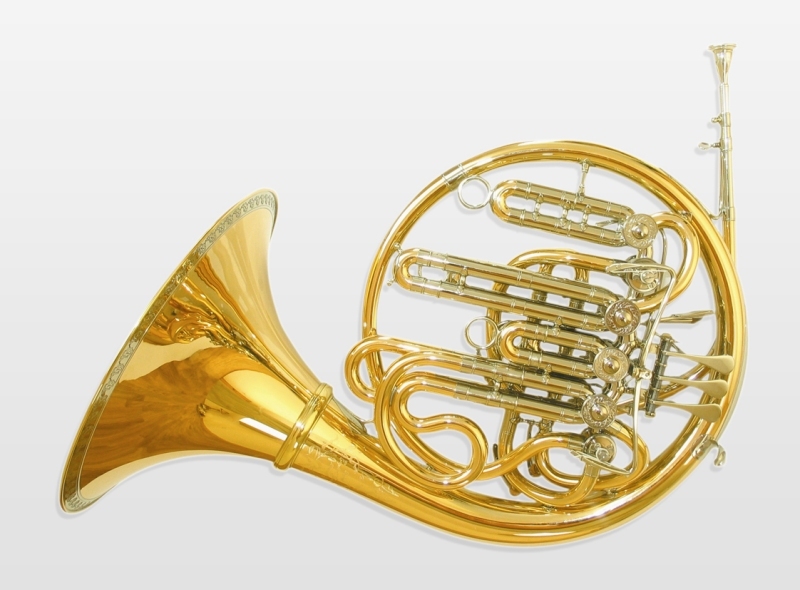
Actually, it is more logical to go up a fourth from Bb. Intonation, fingerings and sound are better and more alike than with the combination with high F. The length of the high Eb horn allows a full-length bell branch and a leadpipe that is even longer than that of a double horn. Three water keys recommended. Weight: 2,100 g.
Compensating triple horn Bb/F/high Eb
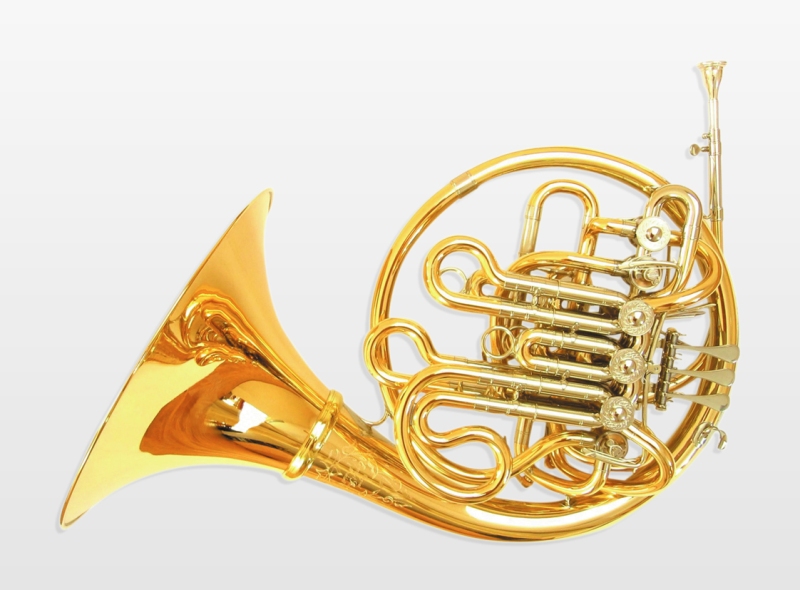
Lighter than a normal double horn, the Bb side fully competitive with that of a double horn, and the switch to the high Eb side without a change in sound (when changing from Bb [0] to high Eb [2+3], the instrument only becomes a half step shorter). A surprisingly good combined low F horn. Four water keys recommended; because they are placed correctly, they cause no acoustic disadvantage at all! Weight: 2,300 g.
Full triple horn Bb/F/high Eb
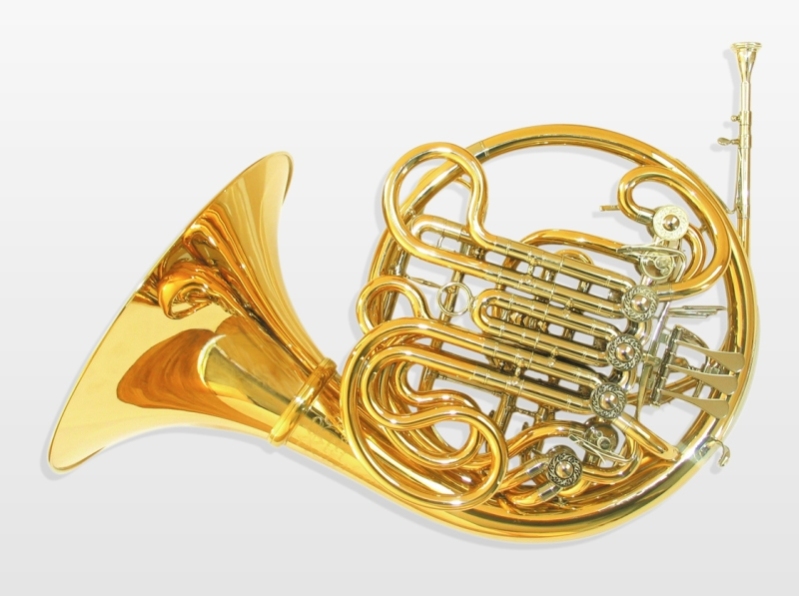
Lighter than a normal double horn with stopping valve. This model practically matches the sound concept of the double horn player. Even the colleague sitting next to you won't be able to tell whether you played on the Bb or the high Eb side. A full, juicy forte is possible on high Eb, and it gives ample security up into the highest range. The fully developed low F side is good even for low horn players. 3 or 4 water keys recommended. Weight: 2,650 g.