
Original Engelbert Schmid mouthpieces
There are four rim widths to suit individual lip sizes. For each rim width there are six cups – shallow, medium shallow, medium, medium deep, deep and extra deep – in order to achieve a brighter or darker sound, an easier high register or a more voluminous low register.
New development: digitally produced mouthpieces
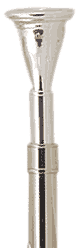
Traditional production
Traditionally, mouthpieces are made by copying a handmade master with tools that have to be sharpened again and again. Although the master may be very good, the curvature can never be 100% ideal when it is made by hand. In addition, repeatedly sharpening the tools leads to certain tolerances in series production over time.
The traditional Original or Model Engelbert Schmid mouthpieces, which have existed since 1981, are made with the utmost care from masters that Engelbert Schmid turned by hand himself. This very successful series of mouthpieces will be continued, with only two minor improvements:
- The shank now has a uniform taper on all Engelbert Schmid mouthpieces, between Morse and metric, so that it fits just about any mouthpipe.
- Exact geometric research showed that the bore must increase by 2/10 mm at each step from shallow through medium shallow, medium and medium deep to deep.
Digital production
The future of producing the acoustically crucial parts of a horn, from the mouthpiece to the bell, lies in the use of electronics.
Engelbert Schmid has therefore determined the ideal curvatures for mouthpieces No. 4 to No. 15.5. In addition, the long-planned mouthpieces No. 1 to No. 3.5 are now available as funnel-shaped Viennese-style mouthpieces without a bowl, with funnels from shallow to extra deep. Viennese mouthpieces are generally very deep. For example, No. 2.0 (medium by Viennese standards) is comparable in depth to No. 9 (deep by German standards). For a fourth horn player outside Vienna, No. 2.5 (medium deep by Viennese standards, but extra deep by German standards) will usually be deep enough. The funnel mouthpieces have more of an “oo” vowel in their tone color, an advantage for many horn players who tend toward a bright sound. The bores of the funnel mouthpieces are generally somewhat larger, which with certain lips can increase the amount of noise in the sound.
These ideal curvatures were then digitized, and the mouthpieces are turned from the stored data with wear-free tools, so they will stay exactly the same for all time. Incidentally, normal digital copying lathes also copy all the small imperfections of the master and add their own copying errors. The digital production of Engelbert Schmid mouthpieces therefore has nothing to do with existing digital copying lathes.
Changes in the digital mouthpieces
The exact geometric measurement of the mouthpieces, which have existed in their traditional version since 1981, has led to small, logical changes in the digital version:
- The rim is now perfectly comfortable, just as Engelbert Schmid had always imagined it.
- All mouthpieces now have a uniform wall thickness of 1.7 mm around the cup, which has a positive effect on the way they vibrate. So you can already tell from the outside whether a mouthpiece has, for example, a shallow cup.
- The bore must increase in steps of 2/10 mm from shallow to deep. We have also adopted this change for the traditional mouthpieces.
- The steps in cup depth from shallow to deep are now evenly spaced. Shallow, medium shallow and deep correspond very closely to the depth of the traditional cups. Medium and medium deep, however, used to be a little deeper than would have been logical.
This means that the digital medium and medium deep mouthpieces are a little shallower than the traditional ones you may be used to. To get the sound you want, you may need to go half a step deeper than before.
The advantage of the digital mouthpieces lies in even greater efficiency and perfect reproducibility.
The complete range
Here is the complete range of Original Engelbert Schmid mouthpieces (dimensions in mm):
| Model No. | Cup depth | Cup shape | Inner rim diameter | Outer rim diameter | Rim width | Bore | Versions |
|---|---|---|---|---|---|---|---|
| No. 1.0 | shallow | funnel-shaped | 17.5 or 18 | 25.5 or 26 | 4.0 | 4.0 | digital only |
| No. 1.5 | medium shallow | funnel-shaped | 17.5 or 18 | 25.5 or 26 | 4.0 | 4.2 | digital only |
| No. 2.0 | medium | funnel-shaped | 17.5 or 18 | 25.5 or 26 | 4.0 | 4.4 | digital only |
| No. 2.5 | medium deep | funnel-shaped | 17.5 or 18 | 25.5 or 26 | 4.0 | 4.7 | digital only |
| No. 3.0 | deep | funnel-shaped | 17.5 or 18 | 25.5 or 26 | 4.0 | 5.0 | digital only |
| No. 3.5 | extra deep | funnel-shaped | 17.5 or 18 | 25.5 or 26 | 4.0 | 5.4 | digital only |
| No. 4.0 | shallow | slightly bowl-shaped | 17.0 | 25.0 | 4.0 | 3.6 | digital or traditional |
| No. 4.5 | medium shallow | slightly bowl-shaped | 17.0 | 25.0 | 4.0 | 3.8 | digital or traditional |
| No. 5.0 | medium | slightly bowl-shaped | 17.0 | 25.0 | 4.0 | 4.0 | digital or traditional |
| No. 5.5 | medium deep | slightly bowl-shaped | 17.0 | 25.0 | 4.0 | 4.2 | digital or traditional |
| No. 6.0 | deep | slightly bowl-shaped | 17.0 | 25.0 | 4.0 | 4.4 | digital or traditional |
| No. 6.5 | extra deep | slightly bowl-shaped | 17.0 | 25.0 | 4.0 | 4.6 | digital |
| No. 7.0 | shallow | slightly bowl-shaped | 17.5 | 25.5 | 4.0 | 3.7 | digital or traditional |
| No. 7.5 | medium shallow | slightly bowl-shaped | 17.5 | 25.5 | 4.0 | 3.9 | digital or traditional |
| No. 8.0 | medium | slightly bowl-shaped | 17.5 | 25.5 | 4.0 | 4.1 | digital or traditional |
| No. 8.5 | medium deep | slightly bowl-shaped | 17.5 | 25.5 | 4.0 | 4.3 | digital or traditional |
| No. 9.0 | deep | slightly bowl-shaped | 17.5 | 25.5 | 4.0 | 4.5 | digital or traditional |
| No. 9.5 | extra deep | slightly bowl-shaped | 17.5 | 25.5 | 4.0 | 4.7 | digital |
| No. 10.0 | shallow | slightly bowl-shaped | 18.0 | 26.0 | 4.0 | 3.8 | digital or traditional |
| No. 10.5 | medium shallow | slightly bowl-shaped | 18.0 | 26.0 | 4.0 | 4.0 | digital or traditional |
| No. 11.0 | medium | slightly bowl-shaped | 18.0 | 26.0 | 4.0 | 4.2 | digital or traditional |
| No. 11.5 | medium deep | slightly bowl-shaped | 18.0 | 26.0 | 4.0 | 4.4 | digital or traditional |
| No. 12.0 | deep | slightly bowl-shaped | 18.0 | 26.0 | 4.0 | 4.6 | digital or traditional |
| No. 12.5 | extra deep | slightly bowl-shaped | 18.0 | 26.0 | 4.0 | 4.8 | digital |
| No. 13.0 | shallow | slightly bowl-shaped | 18.5 | 26.0 digital, 26.5 traditional | 3.75 digital, 4.0 traditional | 3.9 | digital or traditional |
| No. 13.5 | medium shallow | slightly bowl-shaped | 18.5 | 26.0 digital, 26.5 traditional | 3.75 digital, 4.0 traditional | 4.1 | digital or traditional |
| No. 14.0 | medium | slightly bowl-shaped | 18.5 | 26.0 digital, 26.5 traditional | 3.75 digital, 4.0 traditional | 4.3 | digital or traditional |
| No. 14.5 | medium deep | slightly bowl-shaped | 18.5 | 26.0 digital, 26.5 traditional | 3.75 digital, 4.0 traditional | 4.5 | digital or traditional |
| No. 15.0 | deep | slightly bowl-shaped | 18.5 | 26.0 digital, 26.5 traditional | 3.75 digital, 4.0 traditional | 4.7 | digital or traditional |
| No. 15.5 | extra deep | slightly bowl-shaped | 18.5 | 26.5 | 3.75 | 4.9 | digital |
How to choose your mouthpiece
- Decide on your inner rim diameter.
- Check your tone color with the medium deep cup, i.e. No. 2.5, No. 5.5, No. 8.5, No. 11.5 or No. 14.5. If you want a brighter sound, try the next shallower cup. If you want a darker sound, try the next deeper cup.
Engelbert Schmid mouthpieces are usually played with the original bore. For individual needs it can sometimes be an advantage to enlarge the bore by one or two tenths of a millimeter. In this case the lower part of the cup has to be adapted to the new bore.