
Bell sizes
We describe the characteristics of the five bell sizes for valve horns: Vienna horn size, kompakt, Golden Cut (medium), wide and Hollywood Sound. With Engelbert Schmid horns you can switch between sizes simply by exchanging the detachable bells. Hollywood Sound is normally only an option for 4th horn, so as a rule hornists choose between kompakt, Golden Cut (medium) and wide.
- Vienna horn size: The Vienna horn bell size was developed primarily for the Vienna horn with pump valves, but all rotary valve horns are also available with the Vienna horn bell size. The bell (including the bell tail) is compatible with all rotary valve horns; the screw ring is smaller, as on Vienna horns. The edge comes very early, but with a deep mouthpiece you get a rich sound full of colours.
- Kompakt: The detachable bell flare is the same as on Golden Cut. The bell tail is slightly narrower, which gives the sound an earlier core.
- Golden Cut (M): Elegant, clear, carrying tone, with slight advantages over the wide bell in the high register.
- Wide (W): Full but not dull, carrying, sonorous. With a disciplined hand position (straight and not too far out) you can compensate for the slight disadvantages in the high register.
- Hollywood Sound (HWS): Extremely round and full, ideal for 4th horn if the player has the air to fill this bell, and for studio recordings in the style of Hollywood film music. You get a big volume of sound with a very late edge. Everyone knows the traditional horn sound of Hollywood films, recorded on Kruspe copies. Our Hollywood Sound bell is an exact copy of the Kruspe Wendler model, which Hermann Baumann liked to use for recordings.
Alloys
You also have the choice between four alloys:
- Brass (MS): Elegant, bright (yet with depth of sound), smooth, with tone colours ranging from sweet to piercingly brassy. The most versatile alloy in terms of sound! Players whose embouchure naturally produces a warm sound should choose brass. For approximately 80% of horn players, MS is the right choice. Strongly alkaline saliva can slowly corrode brass from the inside. This is not a serious problem, however, as the mouthpipes on brass horns are generally made of nickel silver.
- Gold brass (GM): A little smoother and darker, but clear, round and rich; fewer tone colours are possible than with brass. Some embouchures sound a little shallow on brass and need gold brass. Permanently resistant to saliva. Some players prefer gold brass simply because of its noble colour.
- Nickel silver (NS): Contains no silver; the nickel content alone gives it its silvery colour. The sound is dark in piano and very bright in fortissimo. Only an option with wide or extra wide bells. To European ears, the sound of nickel silver is not as noble as that of the other alloys. In America there is still a tradition of nickel silver horns, but it is steadily declining. Permanently resistant to saliva.
- Sterling silver (SS): Contains 92.5% pure silver, the rest is copper. Engelbert Schmid is the only maker so far to have succeeded in producing truly thin-walled sterling silver horn bells with a diameter of 310 mm. The sound is especially round, so the medium size is usually sufficient for any horn player. It sounds noble and never becomes brittle or too aggressive in fortissimo. From piano to mezzoforte it speaks very easily with a round sound (ideal for lyrical passages); in fortissimo the sound stays round but is more tiring to play than the other alloys. Resistant to saliva and the only alloy that is also resistant to hand perspiration! Beautiful to look at, for example combined with a gold brass garland. We also offer instruments with all conical parts made of sterling silver (mouthpipe, bell branch and bell); the cylindrical parts are then made of gold brass.
The alloy of the detachable bell determines around 60% of the sound characteristics. In other words, a brass horn with a gold brass bell sounds more like a gold brass horn than a gold brass horn with a brass bell.
With or without garland?
Adding only about 60 g, the tastefully decorated garland from Engelbert Schmid does not deaden the sound. The garland adds a little more resistance and a somewhat rounder sound; the brassiness starts later, but then comes more suddenly. Without the garland, the transition to a brassy sound is more even. About 20% of horn players sound better on a bell with the discreet garland from Engelbert Schmid.
Spun or hand hammered (HH)?
Spun bells are pressed from a disc. The sound is good and healthy – modern, so to speak. If you tap the rim with your finger, the bell rings like a bell, more than a hand hammered one. Pressing from a disc makes the material thin near the screw ring, while it stays thicker towards the rim.
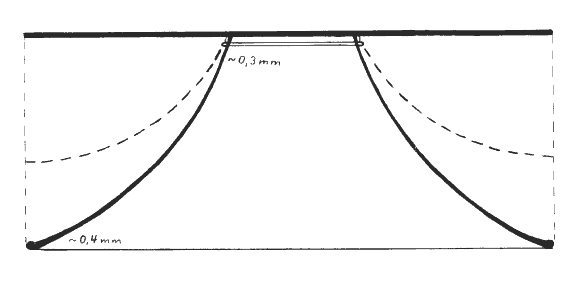
Spun bell
Of course we use special methods to keep this natural difference in material thickness within narrow limits, but it cannot be avoided completely.
Our hand hammered bells are cut from one piece of sheet metal, bent into shape, soldered at Engelbert Schmid with a single seam (without a gusset) and hammered by hand into their symmetrical shape. Only in the last step are they put on the spinning lathe and fitted exactly to the bell form by turning and pressing. Because of the necessary stretching of the material in the flare, the metal becomes very thin towards the rim. Near the screw ring it stays thicker than on a spun bell and is therefore more resistant to hand perspiration.
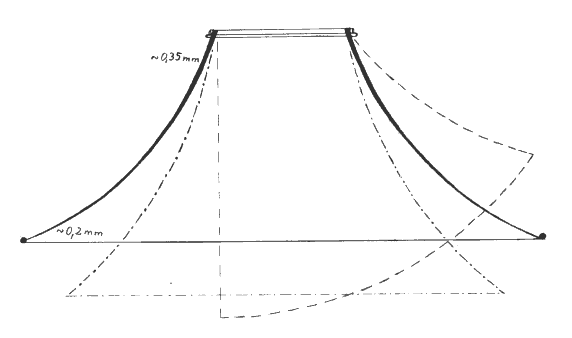
Hand hammered bell
Without a garland, the rim is easily bent. There is no danger, however, as long as you do not lift the horn by the edge of the bell. With Engelbert Schmid bells, a bent rim can easily be restabilised. Stability, not sound, was probably the original reason for adding garlands.
Hand hammering stresses the material to an extreme and changes its structure, which certainly changes the sound too. The crucial factor, however, is that the material becomes thinner towards the end, farther from the energy source, and therefore vibrates better. A hand hammered bell sounds old-fashioned, so to speak, and darker than a spun bell. The thin rim gives the tone a core that is felt to be very warm even in piano, and at the same time the brassiness sounds more pleasant in fortissimo. Hand hammered bells are available with or without garland.
As far as I know, we are the only ones to offer hand hammered bells this thin with a diameter of 310 mm. Even 0.05 mm more wall thickness makes the instrument much harder to play and less flexible. A hand hammered bell must be really thin. Almost everyone who has the chance to compare prefers the hand hammered bell to the spun one.
Fixed or screw bell?
A fixed bell has slight aesthetic advantages, but it is much bulkier when packed (in a fitted case or fitted gig bag), makes repairs more difficult and robs the horn player of the possibility of changing the sound by exchanging bells – of having several instruments in one, so to speak. There is almost no difference in sound between a fixed and a detachable bell, because in the area of the screw ring the hand largely dampens the vibrations of the metal anyway. Our screw ring weighs only about 100 g and is still very stable.
Lacquered or unlacquered?
It is not possible to claim that lacquer does not affect the sound. With a thickness of 0.02 mm on the inside and outside, this plastic coating accounts for approx. 10% of the material thickness. Unlacquered sounds a little more centred, which some people find brighter, some darker, some smoother and some harder. My observation and feeling is that lacquer dampens the high overtones and thus also the extraneous noise in the tone, so the sound becomes clearer – which some perceive as brighter, although acoustically it is darker.
In my experience, the difference in sound is small, and more than 50% of horn players sound better on a lacquered instrument. The lacquer is more resistant to hand perspiration than the metal, so the instrument lasts longer, and it saves the player from green hands. A shiny horn always makes a better impression on the audience. In my eyes, the advantages of lacquer clearly outweigh the disadvantages. A detachable lacquered bell sounds good too, perhaps even better. In any case, whether a horn player has a beautiful tone does not depend on this at all. The player's own sensitivity to sound is the deciding factor.