Classical Natural Horns
The invention horn after Ignaz Lorenz for the Viennese Classics up to Schumann, and the Cor Solo with a larger bore for more volume – my two classical natural horns.
1. Invention horn after Ignaz Lorenz, Linz
Comparing original horns by Ignaz Lorenz from around 1860 with horns made by his successors gave rather mixed results, with appalling acoustic flaws in the cylindrical section. What captivated me in all of them, however, was the fundamental sound of the bell. Again and again I had the impression that this was the true horn sound.
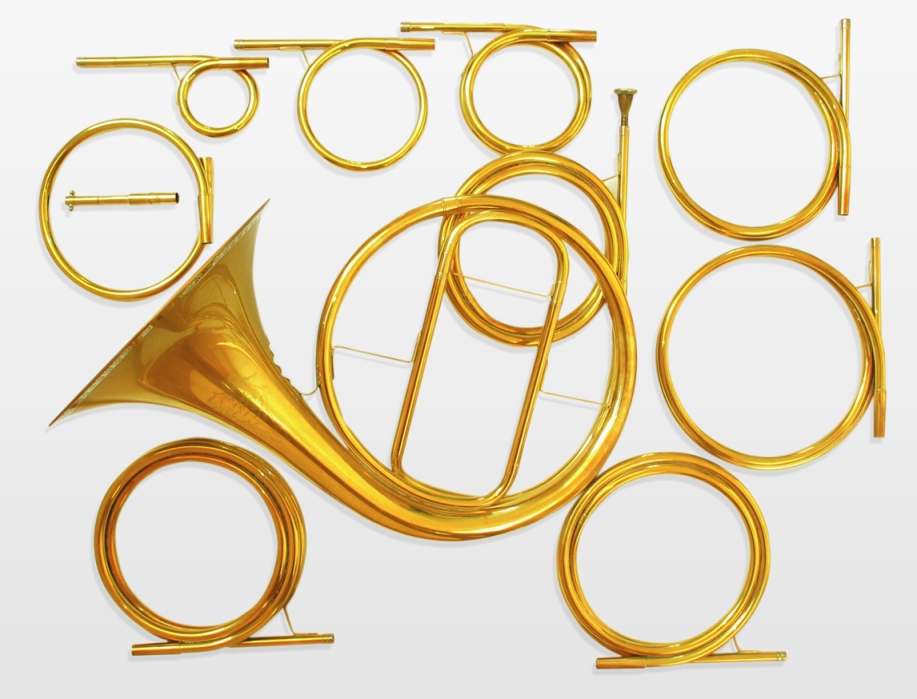
Invention horn after Ignaz Lorenz, Engelbert Schmid
Description of my Ignaz Lorenz copy
- Use: From Joseph Haydn, ideal for the Viennese Classics, up to Robert Schumann.
- Keys: From high C to low Bb (at A = 443 Hz, A = 430 Hz and A = 415 Hz), crooks, two kinds of tuning slides.
- Bell: Hand-hammered with garland, or spun with garland, thin-walled, bell diameter 28 cm.
- Bore, cylindrical section: 11.2 mm.
- Intonation, response: Correcting the intonation flaws and bore jumps of the originals was no problem. The result is a captivatingly clear response and pure intonation, easy to modulate with the hand.
- Finish: For all 4 natural horn models presented here, I recommend the beautiful historical patina obtained by the special method of “smoking”.
- Weight: 1,000 g with Eb crook.
<a id="Cor-Solo-en"></a>2. Cor Solo
A key experience for me was a performance of the Double Concerto by Haydn (Rosetti?) for 2 natural horns and (in this case modern) orchestra. About 50% of the notes of the first natural horn soloist could not actually be heard, but at best guessed. Even if this was partly due to the player and the conductor, it is still an example of how the historical bore of about 11 mm is often too narrow when playing together with modern instruments, or as a soloist in front of a modern or period orchestra.
The solution is my Cor Solo, which is not a copy of a historical model but contains many improvements of my own.
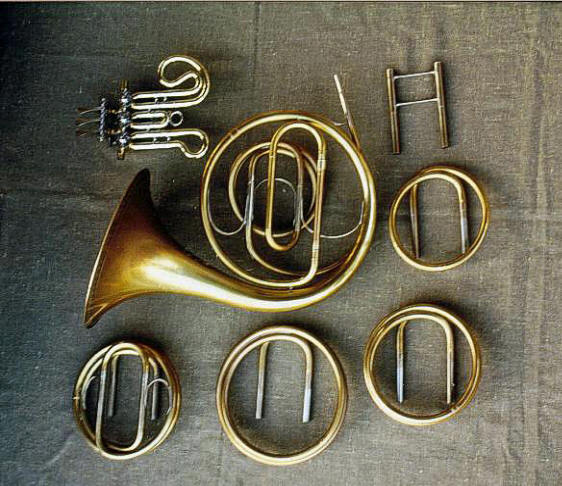
Cor Solo
Description of my Cor Solo version
- Sound: Similar in timbre to the historical instruments, but distinctly bigger in volume.
- Bell: Similar to the Lorenz copy, hand-hammered with garland or spun with garland, bell diameter 28 cm, thin-walled.
- Construction: Fixed leadpipe, crooks inserted in the middle. With just 5 crooks you can reach all keys from high Bb to low Bb at A = 443 Hz, A = 430 Hz and A = 415 Hz. In addition, by inserting a valve section you can turn it into a 3-valve Bb horn or F horn within seconds.
- Bore: 12.0 mm in the cylindrical section, fixed leadpipe for all keys. This gives you a feel similar to the modern valve horn, fewer problems when switching, and still largely the sound of the natural horn.
- Intonation, response: No problems in any key. As with the Lorenz copy, the bell flare is very well suited to hand-stopping.
- Weight: 1,100 g with Eb crook.
- Aesthetics: In shape and craftsmanship, all 4 natural horn models presented here are a feast for the eyes, like all Engelbert Schmid horns.